
TrueClays · Training
Squad rotation
Shooting alone means every target comes the moment you are ready for it. On a real range you wait while the rest of the squad shoots, then step up cold. Squad rotation puts that wait back into your training.
What it does
When squad rotation is on, the simulator stops listening for your call after each of your turns. It holds the microphone closed for as long as the rest of a squad would have taken, then opens it again. You cannot call the next target until your turn comes round, exactly as on a real range.
The point is the gap, not the delay. Standing off the gun for thirty or forty seconds and then mounting for one target is a different skill from firing a hundred targets back to back. Rhythm, routine and the first-target-after-a-wait problem are all things you can only practise if the wait is there.
Works in every disciplineNo effect on scoringOff by default
Turning it on
Open Configuration from the main menu and choose the Training tab.
Find the Squad rotation panel and switch on Simulate squad rotation.
Set the squad size, the time per shooter and the cue you want, then press Apply.
Start a round as normal. Your first target comes straight away — the wait begins after your first turn.
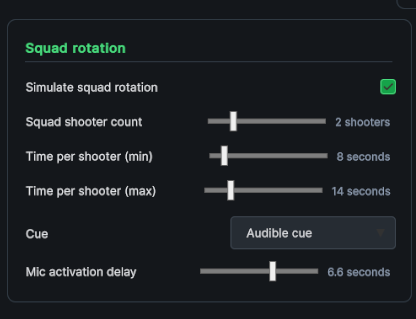
The settings
-
Simulate squad rotation
Turns the whole feature on and off. With it off, nothing else in this panel has any effect and the simulator behaves as it always has.
-
Squad shooter count
How many people are in the imaginary squad. Six means you wait for five others between your turns. One means you wait for nobody, which is the same as switching the feature off.
-
Time per shooter
How long one other shooter takes for their turn. Each turn is drawn at random between the two values, so the total wait is never quite the same twice. Set them to the same number if you want a fixed rhythm.
-
Cue
How you are told your turn is coming. See Choosing a cue below.
-
Mic activation delay
The gap between the shooter before you finishing and your microphone going live. This is your walk-up and mount time. Longer settings give you room to take your stance properly; shorter settings put you under pressure.
Choosing a cue
Audible cue
You hear the shooter immediately before you: their call, then their shot. Nothing else breaks the silence. After their shot you have the mic activation delay to get ready, and then the range is listening.
This is the closer match to a real squad and the better choice for most training. It trains you to pick your moment off a sound rather than off a number, which is what you will be doing at a competition.
Screen countdown
A timer on screen counts down to your turn. The last ten seconds show tenths, and the number changes colour in the final three seconds.
Use this when you are working on a fixed pre-shot routine and want to know exactly how much time you have, or when you are coaching and want the shooter to see the clock.
In both modes a banner reads Others are shooting while you wait, so it is always clear that the range is quiet on purpose rather than not hearing you.
During the wait
Your score, your shot data and the rest of the display stay exactly as they were. Nothing is being scored and nothing is running down. The only thing that changes is that the microphone is closed.
Calling during the wait does nothing, and it does not count against you. When your turn arrives the banner clears, the microphone opens and you call as normal.
A no-bird or a re-shoot does not start a wait. The squad does not rotate for a target that was never presented, so you shoot it again straight away.
Shooting with other people
If there is already more than one shooter in the squad, those people produce a real wait on their own. The simulator subtracts them and only makes up the difference.
With the count set to six and three real shooters on the range, you wait for three imaginary ones. With six real shooters, nothing is simulated at all and the setting quietly does nothing.
Starting points by discipline
A turn means something different in each discipline. In the trap family the squad changes shooter after every single target, so a turn is short. In skeet and the sporting disciplines a shooter completes the whole stand before handing over, so a turn is much longer.
These are starting points, not rules. Time a real squad at your own club and set the numbers to match.
| Discipline | Time per shooter |
|---|---|
| Olympic Trap, ABT, Nordic Trap | 5 to 10 seconds |
| American Trap | 5 to 10 seconds |
| Helice | 10 to 18 seconds |
| Olympic Skeet | 20 to 35 seconds |
| Sporting, Compak, English Sporting | 25 to 45 seconds |
Because a turn is short in trap and long in skeet, expect to change the time per shooter when you switch discipline. The setting is shared across all of them.
If something looks wrong
| What you see | What to check |
|---|---|
| No wait at all | Squad shooter count is 1, or a full squad of real shooters leaves nothing to simulate. Check that Simulate squad rotation is on and that Apply was pressed. |
| The range never starts listening | Time per shooter may be set far higher than intended. Check the maximum value and multiply it by the number of other shooters to see the longest possible wait. |
| No call or shot is heard | The cue is set to Screen countdown, or the range volume is down. Audible cue plays only for the shooter directly before you, not for the whole squad. |
| No countdown on screen | The cue is set to Audible cue. Switch it to Screen countdown and press Apply. |
| The wait feels wrong for the discipline | Time per shooter is shared across every discipline. See the starting points above and adjust for the one you are shooting. |
Getting the most from it
Train the wait, not just the shot. Come off the gun properly between turns, open the action, and go through the same routine you would use on a real stand. A wait you spend already mounted teaches you nothing.
Start with the audible cue and a generous mic activation delay, then shorten the delay as your routine gets tighter. If you find yourself rushed at four seconds, that is a useful thing to know before it happens at a competition.
Leave the minimum and maximum times apart. A squad never takes the same time twice, and training against a predictable clock builds a rhythm that will not survive contact with a real squad.