
For coaches and instructors
Why coaching is easy in TrueClays
On a real range a coach works from the outcome: the clay broke, or it did not. In TrueClays the coach works from the cause. The barrel path is measured, the shot is shown back within the same second it was taken, and the same target can be repeated until the movement is right.
The barrel analyzer shows what the eye cannot
This is the tool most coaches end up using first and keep using. Instead of guessing why the shot missed, you get the barrel's actual path against the clay: where the muzzle was, how it moved, where it was pointing at the moment the trigger broke.
That turns a coaching conversation from opinion into evidence. "You stopped the gun" becomes a line the shooter can see stopping. Shooters who argue with a coach rarely argue with their own barrel track, and the ones who cannot feel a fault can usually recognise it on screen.
It also separates faults that look identical from behind. Missing behind, stopping the gun, and a late trigger all end the same way on a real range. Here they look completely different.
The barrel's actual path
Where the muzzle was, how it moved, and where it was pointing at the moment the trigger broke — measured against the clay, not guessed at from behind the shooter.
Every shot replays, with the correct lead drawn in
Their attempt and the correct answer, together
The shooter sees their own barrel track and where it needed to be for a centred hit — in the same frame, at their own sight picture, at their own speed. Nothing has to be described.
Any shot can be played back immediately, at the shooter's side, with the barrel analysis on top and an indicator showing where the barrel needed to be for a centred hit. The shooter sees their own attempt and the correct answer in the same picture.
There is no "you were about a foot behind" — the gap is on screen, at the shooter's own sight picture, at the shooter's own speed.
Replay right after the shot, while the sight picture is still fresh in the shooter's head. Waiting until the end of the round loses most of the value.
Feedback fast enough for the brain to learn from
The brain learns from what happens the instant it acts. Feedback that arrives a second late is information; feedback that arrives immediately is learning — and it is the part coaches notice without being able to name.
Real-life break timing
The clay breaks in about the same timeframe as on the range, so the shooter's nervous system ties the break to the movement that produced it. Nothing has to be consciously understood for the correction to stick.
The debris shows the hit
Fragments are thrown in the direction the pattern came from. Catch the clay on the right and the pieces go left. A shooter chipping the back edge sees it, shot after shot, and starts correcting before anyone says a word.
The shot made visible
Turn it on and the pattern flies as a semi-transparent cloud, so the shooter actually sees their own shot travel and pass the clay — the most convincing demonstration for a shooter who insists they were in front.
Show pellet cloud is a teaching aid, not a training mode. Use it to prove a point, then turn it off — leaving it on lets the shooter chase the cloud instead of building the sight picture.
Shooter, gun and target in one field of view
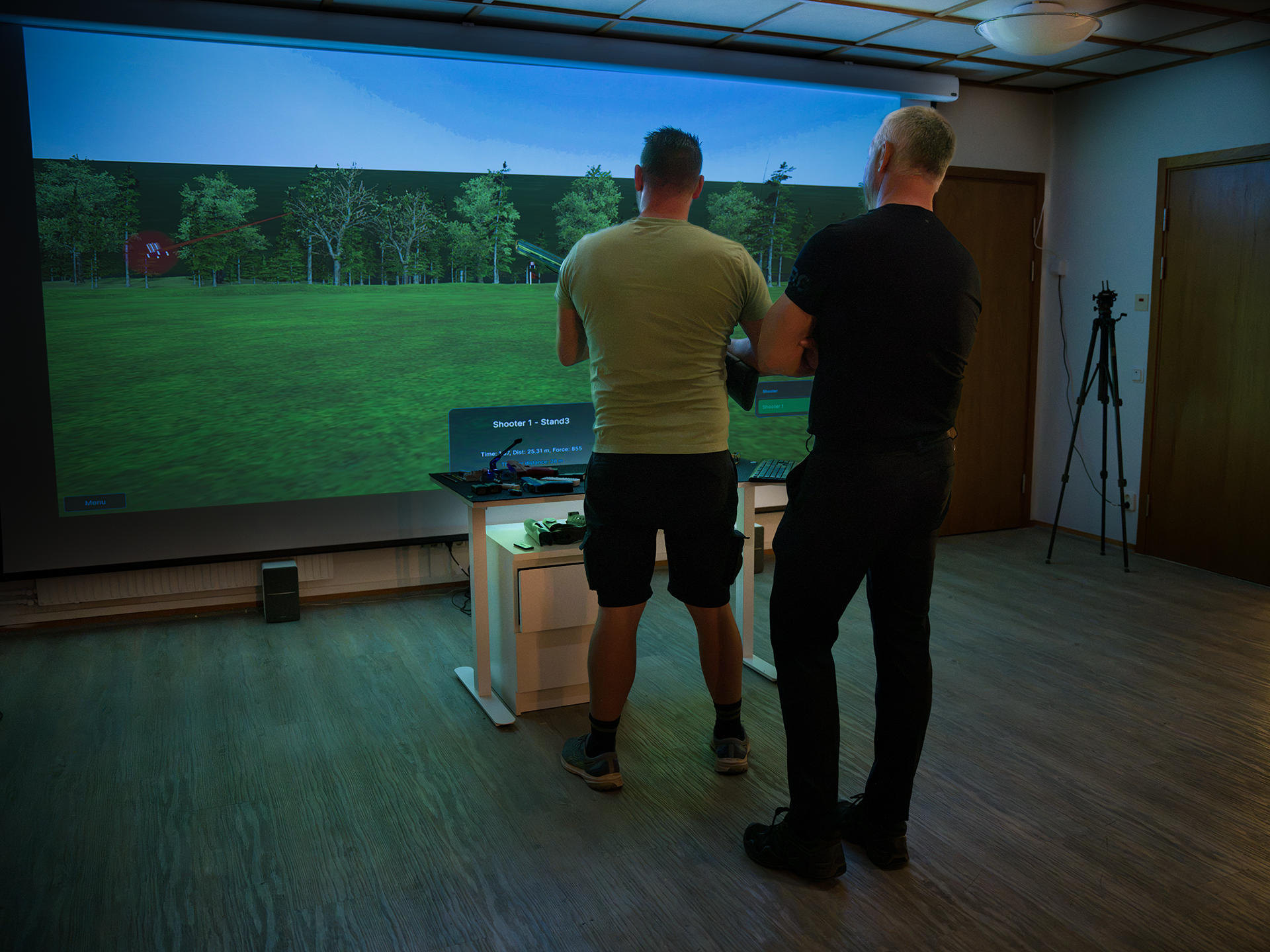
Standing behind the shooter, the coach sees the screen, the gun and the shooter at roughly the same depth. Everything that matters is inside one focal plane.
On a real range the coach's eyes have to jump from a gun two metres away to a clay eighty metres out, and a great deal of detail is lost in that jump. Here nothing is lost.
Visible in one glance
Head lift off the comb, a gun that stops, a body that stops rotating, a trigger that comes late, feet that move on the second bird — all of it at the same time as the target.
Repeat the same target until it is learned
Correcting a technical fault takes repetitions, and on a real range repetitions run out. Shells cost money, the trap needs loading, and recoil quietly ends the session long before the learning does — a tired shooter starts managing the gun instead of shooting the target, and then you are coaching a flinch you created.
None of that applies here. The same target can be shot fifty times in a row at no cost, with no recoil fatigue, so the shooter's last repetition is as clean as the first. That is where technique actually changes.
Set up the exact target that is causing trouble
Almost every shooter has one target that loses them competitions. On a real range you rebuild the layout, or you wait until the next event and hope it comes up. Here you set it up in a moment and shoot it until it is no longer the problem target.
Once it is set, everything around it holds still. Same presentation, same speed, same light, unless you deliberately change something — so you can isolate one variable at a time. Change the hold point and nothing else. Change the foot position and nothing else. On a real range no two clays are identical, so you never quite know what you tested.
Coaching works remotely too
Both looking at the same shot
When the coach cannot be in the room, the shooter trains on their own system, the coach follows the shots, and the same barrel analysis and replays are what both of them are looking at.
The trip that never happens
For a shooter with a coach in another country, or a squad spread across clubs, remote coaching replaces the visit that would otherwise never take place.
What else quietly makes coaching easier
A few things that rarely appear on a feature list but change how a session runs.
No live ammunition
The coach can stand anywhere, put hands on the gun, correct a mount mid-movement and talk while the shooter is tracking. On a live range, most of that is either unsafe or impossible.
Perceived Lead
Matches the simulator to how a specific shooter reads lead — or set a small negative value for a session to train out a real-life habit of over-leading.
Neurologic Visual Trainer
Deliberately harder than real life, where a good and a bad shot are separated by a few tens of milliseconds. Real ranges give you no way to train that directly.
Clay speed
Training slightly slow builds correct movement. A shooter trained too fast learns a rushed gun, and that is very hard to undo later.
Squad rotation
Puts a real wait between shots, as in a squad, so you can coach the pre-shot routine and the waiting — not just the gun movement.
Recorded sessions
Sessions can be recorded and reviewed after the shooter has gone home, or compared against the same shooter three months earlier.
Indoors, any hour, any season
Weather, daylight and trap crews stop deciding when coaching happens. A dark winter evening becomes a full technical session.
Set-up is what makes it transfer
Coaching in the simulator carries over to the range only if the shooter's set-up is right. Two settings do most of that work.
Shooter height must be correct, especially for Skeet and Trap. The horizon is rendered at eye level, so an incorrect height changes every angle on the layout. And TrueClays cannot know how a particular gun patterns — the shooter has to pattern on paper in real life and match the setting in the simulator.
If a top athlete misses consistently in the same place, change the simulator, not the shooter. A repeated miss in one direction is a set-up signal first and a technique fault second.
The short version
| On a real range | In TrueClays |
|---|---|
| The coach sees the result of the shot | The coach sees the barrel that caused it |
| Feedback arrives after the shooter has moved on | Break, fragments and pellet cloud land in the same moment as the shot |
| Eyes jump between a gun at two metres and a clay at eighty | Shooter, gun and target sit in one field of view |
| Repetitions are limited by shells, traps and recoil | The session ends when the learning does |
| You wait for the problem target to come up | You build the problem target in seconds |
| Weather and daylight decide the lesson | You decide the lesson |
| The coach has to be on the stand | The coach can be anywhere |
A coach on a real range spends the session working out what happened. In TrueClays that part is already answered, and the whole session goes into fixing it.